One of the first questions people ask after price is simple: how long will the whole process actually take?
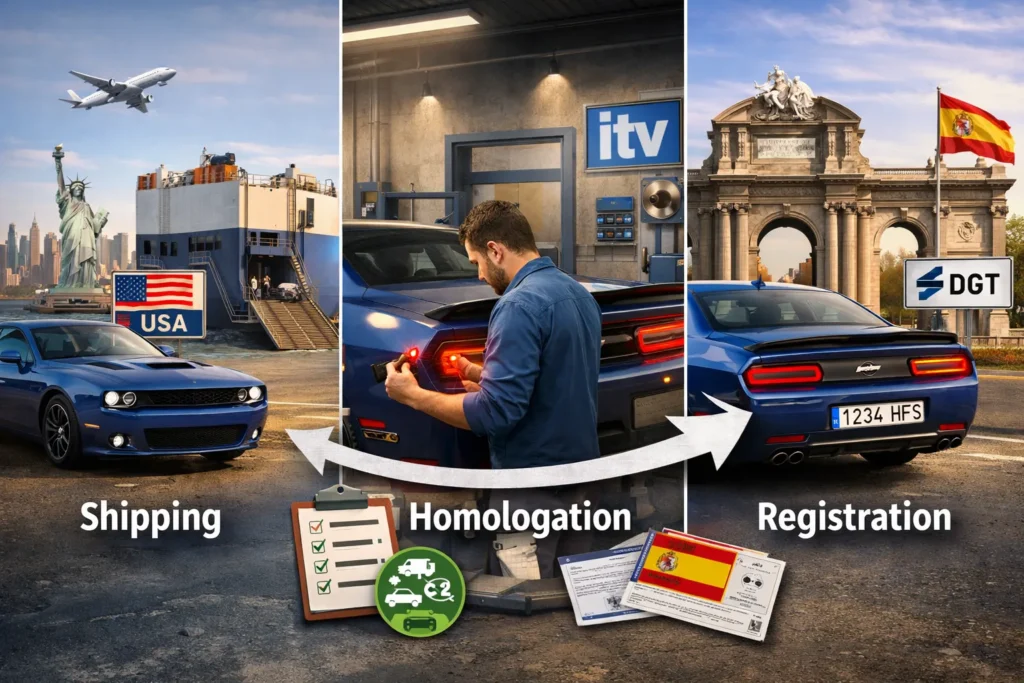
The realistic answer is that importing a car from the USA to Spain is rarely fast. It involves U.S. export paperwork, customs clearance, ocean shipping, European transit, Spanish customs, technical compliance work, ITV inspection, and final registration with the DGT. Spain’s Tax Agency says that, once a vehicle is imported, it must still pass ITV and complete the Spanish matriculation steps before it can circulate legally.
In most real-world cases, a typical overall timeline is around four months, which matches the process outlined in your current import materials.
The short answer
For most standard U.S. vehicle imports, a realistic working estimate is:
Around 3 to 4 months in many cases
That estimate assumes:
- the vehicle has no serious paperwork problems
- shipping space is available without major delay
- the car is eligible for registration in Spain
- the required modifications are straightforward
- homologation and ITV move without major setbacks
Your own process notes state that from arrival at the U.S. port to final Spanish registration, the process typically takes approximately four months.
The full timeline, step by step
Step 1: Buying the vehicle and preparing export paperwork
Before the car even leaves the United States, there is usually a preparation phase involving:
- title and ownership checks
- invoice and purchase documentation
- export coordination
- transport to the departure port
Spain’s Tax Agency notes that customs will require proof of ownership and technical documentation for the vehicle.
Typical timeframe
This stage can take several days to a few weeks, depending on how quickly the title, seller paperwork, and U.S. transport are handled.
If the car is being sourced through auction or from a private seller, delays can easily begin here.
Step 2: U.S. Customs clearance
Before a vehicle can leave the U.S., export clearance must be completed.
Your current FAQ explains that U.S. Customs clearance can take anywhere from one week to several weeks.
Typical timeframe
A realistic allowance is 1 to 3 weeks, although some cases move faster and others do not.
This is one of the first places where DIY imports often lose time.
Step 3: Ocean shipping to Europe
Once the vehicle is cleared and loaded, the next stage is ocean freight.
Your current materials explain that shipping is usually either RoRo or containerised, and that transatlantic routes often go via Amsterdam because this can be more economical and efficient.
Typical timeframe
The sea crossing is usually around three weeks.
That is the voyage itself. It does not include booking delays, loading windows, or port handling at either end.
Step 4: Arrival in Europe and onward transport to Spain
After the vehicle reaches Europe, it still has to move onward into the Spanish system.
Your current process explains that, after arrival, European Customs issue a T1 transit document, and the vehicle is then transported through Europe to Spain, often within about a week.
Typical timeframe
A realistic allowance here is about 1 week, though it can be longer if there are scheduling or logistics bottlenecks.
Step 5: Spanish customs and import entry
Once the vehicle arrives in Spain, it must go through Spanish customs formalities.
Spain’s Tax Agency explains that imported vehicles are subject to customs and tax processing before the later matriculation stage.
Typical timeframe
This stage can vary, but it is often measured in days rather than weeks when the documentation is complete.
If anything is missing, the timeline can slip quickly.
Step 6: Technical modifications and compliance work
This is the part many buyers underestimate.
Your current import material explains that U.S.-spec vehicles often require:
- rear-light conversion
- indicator separation
- rear fog-light installation
- side-marker changes
- tint adjustments
- specialist LED work on modern vehicles
Typical timeframe
This depends entirely on the car.
A simpler older vehicle may move through this stage relatively quickly. A modern car with complex lighting or visible modifications can take much longer, especially if parts or specialist work are needed.
Step 7: Homologation report
Before final registration, many U.S. imports need an individual homologation report.
Your current FAQ states that this report generally takes about one month.
Typical timeframe
A sensible estimate is around 4 weeks.
This is one of the biggest reasons the full process is not “just shipping plus paperwork.”
Step 8: ITV inspection
Spain’s Tax Agency states that, before a vehicle can circulate after import, it must pass ITV in Spain to confirm that it meets the required safety and environmental standards.
Your own materials also confirm that imported vehicles are presented for ITV once the compliance and homologation work is ready.
Typical timeframe
The inspection itself is quick, but the real timing depends on:
- appointment availability
- whether the car passes first time
- whether any deficiencies need correcting
If the vehicle fails ITV, your process notes say the issues are corrected and the car is resubmitted within the permitted timeframe.
Step 9: DGT registration and plates
After ITV, the final stage is registration with the DGT.
Spain’s Tax Agency explains that the registration-tax step is handled through Modelo 576 in the general case, and DGT guidance also confirms that imported vehicles must be rematriculated in Spain after customs and ITV.
This final registration stage typically takes around two weeks.
A realistic example timeline
To make the process easier to visualise, here is a typical working schedule for a standard import:
Week 1 to 2
Vehicle purchase is finalised, export paperwork is prepared, and U.S. transport to port is arranged.
Week 2 to 4
U.S. Customs clearance is completed and the vehicle is loaded for shipping.
Week 5 to 7
Ocean transit to Europe.
Week 7 to 8
European arrival, T1 transit, and transport onward to Spain.
Week 8 to 12
Technical modifications, compliance work, and homologation preparation.
Week 12 to 16
Homologation report, ITV, DGT registration, and plates.
That is why a three-to-four-month window is usually the most honest answer.
What can make the process faster
A vehicle that is already a good candidate for Spain
If the car is standard, unmodified, and relatively straightforward to adapt, the technical stage is usually smoother.
Good paperwork from day one
Complete title, invoice, export paperwork, and technical information help avoid delays at multiple stages. Spain’s Tax Agency specifically lists ownership proof and technical documentation among the key customs documents.
Planning modifications while the car is still in transit
Your current process notes explain that required technical parts and modifications are often prepared while the vehicle is still in transit, so the work can start immediately on arrival.
That is one of the biggest ways to save time.
What usually causes delays
Buying a car before checking eligibility
If the car is difficult to register, the timeline can stretch dramatically. Your current materials make clear that not every U.S. vehicle can be registered in Spain under normal rules.
U.S. export paperwork issues
Small mistakes at the title and export stage can add weeks before the car even leaves America.
Modern LED light conversions
These are often more complex than buyers expect and can require specialist work.
ITV failure on first presentation
If the vehicle fails ITV, the process pauses until the deficiencies are corrected.
Can you drive the car in Spain while the process is ongoing?
In general, no.
Spain’s Tax Agency states that residents in Spain are not allowed to drive imported vehicles indefinitely on foreign plates and says owners have a 30-day limit to matriculate the vehicle in Spain, although it is possible to obtain temporary plates from the DGT while the process is completed. A DGT article also notes 60 days in relocation cases.
That is another reason why proper planning matters.
Frequently asked questions about import timelines
Is shipping the longest part of the process?
Not always. The sea journey is often only around three weeks. In many cases, the longer parts are paperwork, homologation, technical work, ITV, and registration.
Can the whole process be done in under two months?
That would be unusually fast for a full non-EU import into Spain. It may happen in very simple cases, but it should not be treated as the normal expectation.
What is the safest timeline to plan around?
For most buyers, the safest assumption is around four months from U.S. port departure to Spanish registration.
Want a realistic timeline for your vehicle?
If you want to know how long your import is likely to take, the best approach is to assess the actual car before you commit.
Send us:
- make, model and year
- VIN
- clear photos of all four sides
- a rear-light video
- any title or registration documents you already have
We can then tell you whether the vehicle looks straightforward, what compliance work it is likely to need, and what sort of timeline is realistic for your case.