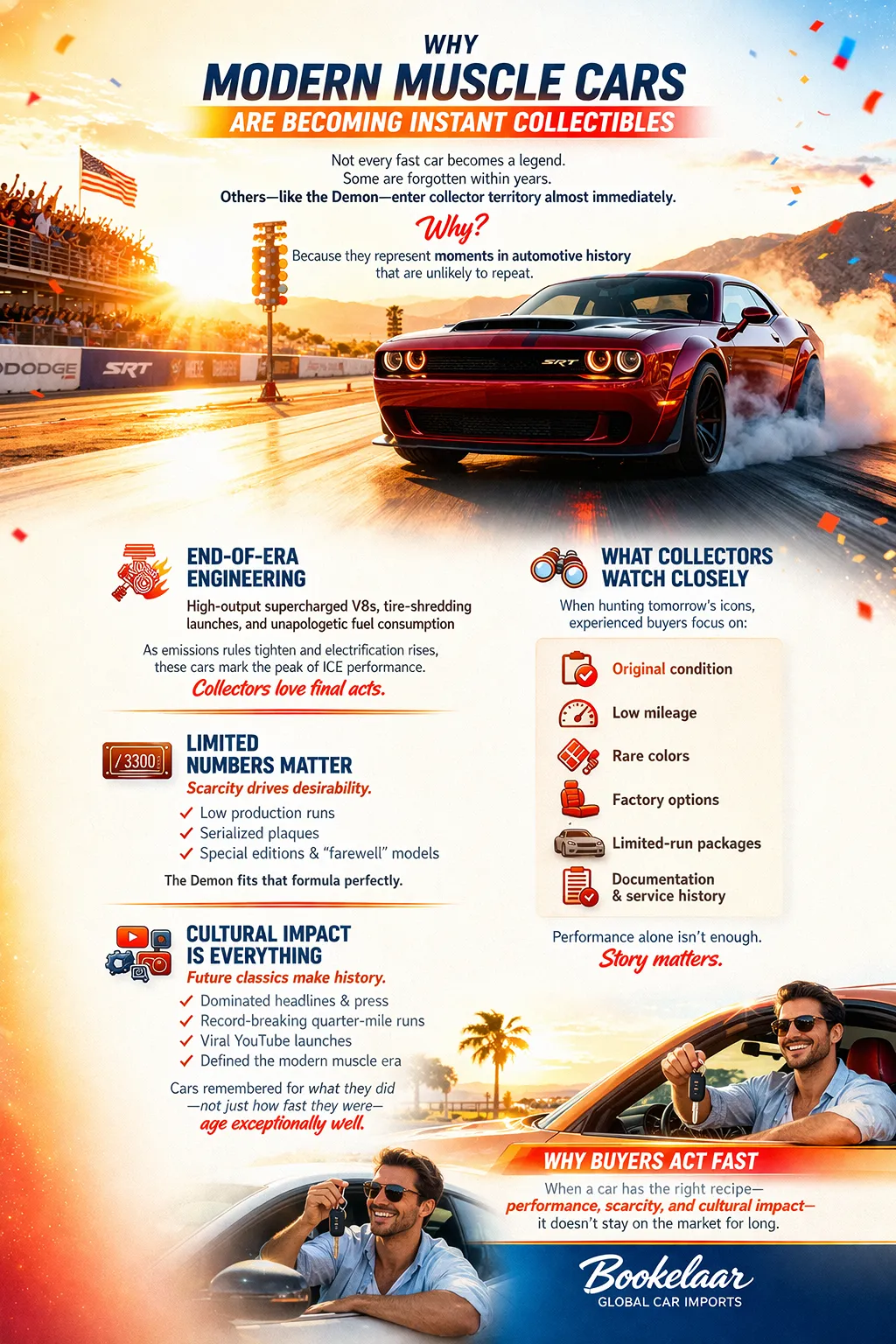
Not every fast car becomes a legend.
Some performance cars arrive with huge hype, then disappear from the conversation a few years later. Others cross into collector territory almost immediately. The difference is usually bigger than horsepower alone.
Cars like the Dodge Demon stand out because they represent a very specific moment in automotive history: powerful, unapologetic, high-drama machines built in an era that is already starting to close. For collectors, that combination can be hard to ignore.
The fastest cars do not always become the most collectible
Speed helps, but speed by itself is not enough.
The market rarely rewards a car simply because it was quick in a straight line or posted strong numbers when new. Plenty of fast cars were mass-produced, widely available, or quickly overshadowed by newer models. They may still be desirable, but that does not automatically make them collectible.
What tends to separate instant collectible cars from ordinary performance models is a mix of rarity, timing, identity, and story. The car needs to feel like it mattered.
End-of-era engineering has real collector appeal
Modern muscle cars are becoming more collectible because many of them represent the peak of a disappearing formula.
For years, American performance was defined by supercharged V8s, rear-wheel drive, dramatic styling, and very few compromises. That formula now faces obvious pressure from emissions rules, electrification, downsizing, and changing manufacturer priorities.
As a result, the wildest combustion-engine muscle cars increasingly look like final chapters rather than stepping stones.
Collectors are drawn to that. They tend to value cars that mark the end of an era, especially when those cars deliver a kind of experience that is unlikely to be repeated in the same form. A brutally powerful supercharged V8 with factory drag-strip credentials feels very different when buyers believe there may never be another one quite like it.
That is one reason “last of its kind” cars often gain attention early.
Limited production numbers matter more than most people think
Scarcity is one of the strongest drivers of collectibility.
A fast car built in large numbers can remain desirable for years, but low-volume models usually have a stronger chance of becoming future classics. When production is limited, the ownership pool stays small and the car feels more special from day one.
Collectors pay close attention to details like:
- low production totals
- numbered plaques
- special editions
- farewell models
- model-year-only features
- unique factory packages
The Dodge Demon fits this pattern almost perfectly. It was not just powerful. It was presented as an event car, built with a clear identity, a limited-run feel, and a specification that immediately separated it from ordinary high-performance trims.
That combination creates a stronger long-term narrative than simple performance figures ever could.
Cultural impact often decides which cars are remembered
Many future classics have something in common beyond rarity: they dominated the conversation.
The cars that age best are often the ones people remember clearly. They broke records, filled YouTube feeds, appeared constantly on social media, and became reference points in enthusiast culture. They were discussed at drag strips, in forums, in magazines, and in everyday car conversations.
That matters because collector demand is partly emotional.
A car with genuine cultural impact becomes a symbol of its era. People do not just remember how fast it was. They remember what it represented, how it made headlines, and how it made them feel when it arrived.
That kind of reputation tends to stick. Years later, buyers are not simply purchasing an engine and a chassis. They are buying a moment in automotive history.
Why the Demon became an instant collectible
The Demon is a strong example because it brought all of the right ingredients together at once.
It had a clear purpose
It was not marketed as a general-purpose performance car. It had a distinct mission and identity. That clarity made it memorable.
It was extreme in a way few factory cars are
Collectors respond to cars that feel excessive in the best possible sense. The Demon was built to shock people, generate headlines, and push factory performance into territory that felt almost unreasonable.
It arrived at the right time
Timing matters. A car launched during a period of growing uncertainty around high-output V8 performance can gain extra significance. Buyers quickly start to see it not just as an exciting new model, but as something unlikely to happen again.
It had rarity and story
That is a powerful combination. A limited-run car with a strong backstory will usually hold collector interest better than a faster but less distinctive alternative.
What collectors look for when buying modern muscle cars
Not every example of a special car will be equally desirable.
Experienced buyers usually focus on the details that protect originality and prove quality ownership over time.
Original condition
Cars that remain close to factory specification tend to attract stronger collector interest. Heavy modifications can reduce appeal, especially when buyers want an unaltered example of an already special model.
Low mileage
Mileage is not everything, but it still matters. Lower-mileage cars usually attract more attention because they suggest less wear and a more preserved ownership history.
Rare colours and specifications
Certain paint colours, interior combinations, and factory options can make one example far more desirable than another. When supply is already limited, unusual but attractive specifications can make a big difference.
Factory options and special packages
Collectors usually prefer rare factory equipment over aftermarket changes. Documentation showing original build details helps support value.
Documentation and service history
Paperwork matters. Original purchase documents, manuals, window stickers, service records, and ownership history all strengthen the story around a car. In collector markets, proof and provenance carry real weight.
Performance alone is never enough
This is where many buyers get it wrong.
They assume a powerful car will automatically become collectible because the numbers are impressive. In reality, performance is only one part of the picture. Plenty of cars are fast. Far fewer feel historically important.
The models that become instant collectibles usually combine several qualities:
- performance
- scarcity
- identity
- cultural relevance
- end-of-era significance
- a story people want to keep telling
That last point matters more than it may seem. Story is often what turns a desirable car into a genuinely collectible one.
Which modern muscle cars are most likely to hold collector appeal?
The strongest candidates usually share a recognizable pattern.
They are often limited-production or farewell models, tied to a major engine, platform, or brand milestone. They may also represent the boldest expression of a formula before regulations or market changes forced manufacturers in a new direction.
Cars with the best long-term collector potential are usually those that people immediately describe in memorable terms: the last one, the wild one, the rare one, the record-setter, or the model that defined its era.
Those are the cars enthusiasts keep talking about long after production ends.
Final thoughts
Modern muscle cars are becoming instant collectibles because the market recognizes when a chapter is closing.
The most sought-after examples are not just fast. They are scarce, culturally significant, and tied to a type of engineering that already feels less common than it did only a few years ago. Cars like the Demon stand out because they were memorable from the start and because they now represent something larger than themselves.
For collectors, that is usually where long-term desirability begins.
If you are considering buying, importing, or registering a special American muscle car, BOOKELAAR can help you assess the practical side before you commit.