Importing a car from the United States to Spain is absolutely possible, but it is not a quick or simple job. It involves U.S. export rules, international shipping, European transit, Spanish customs, technical compliance work, an individual homologation report, ITV inspection, and finally registration with the DGT.
This guide walks you through the full process, explains realistic timelines and cost ranges, and highlights the delays that catch people out.
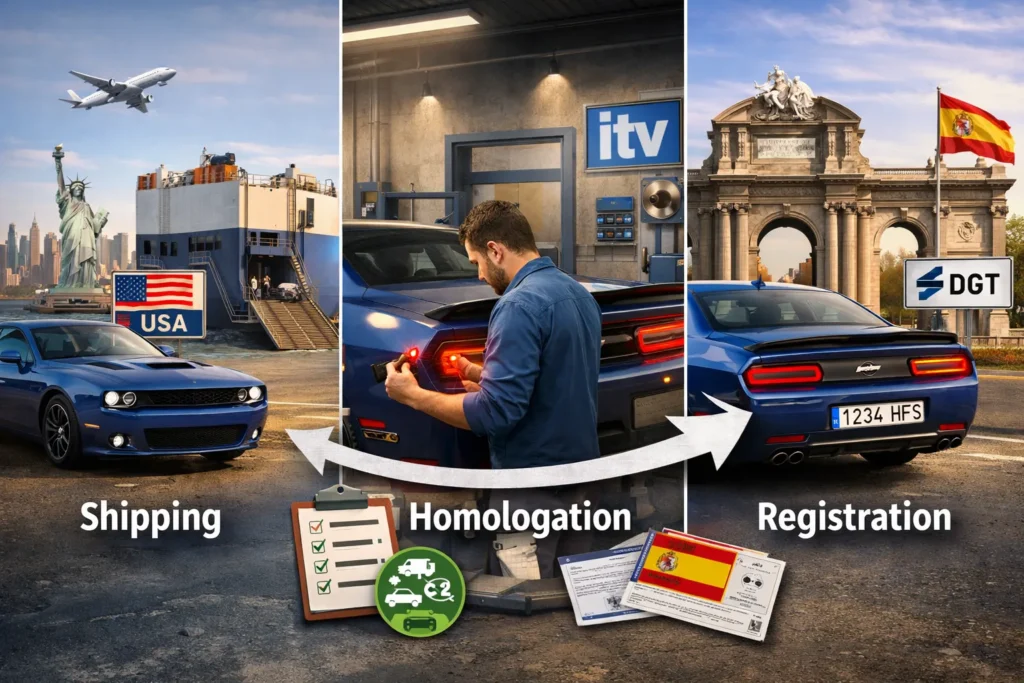
The process at a glance
Typical timeline: around 4 months from U.S. port departure to Spanish plates, depending on paperwork, shipping schedules and homologation workload.
Main stages:
- Buy and verify the vehicle
- Prepare U.S. export documentation and clear U.S. Customs
- Ship to Europe (often via Amsterdam)
- European transit paperwork (T1) and transport to Spain
- Spanish customs clearance
- Technical modifications for EU compliance
- Individual homologation report
- ITV inspection
- DGT registration and plates
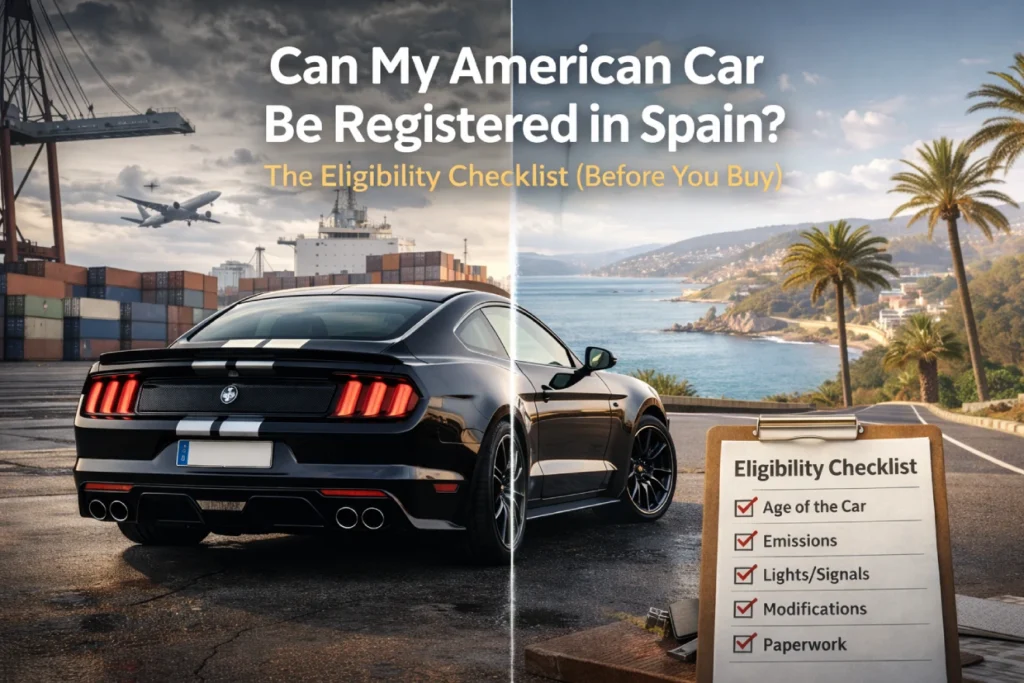
Step 1: Choose the right vehicle (before you buy)
The biggest mistake people make is buying first and asking “can it be registered?” later.
Before purchase, confirm:
- Eligibility for Spanish registration (some models/years may be restricted, especially older technical standards)
- Title status and history (clean, salvage, rebuilt, flood, etc.)
- Modification level (extreme lowering, straight-pipe exhaust and aggressive body kits can block registration)
If you want a fast pre-check, gather:
- Clear photos of all four sides
- A short rear-light video (indicators, brake, reverse, fog if present)
- Any paperwork you have (title, invoice, registration)
Step 2: U.S. paperwork + export preparation
Once the vehicle is purchased, the export side begins:
- Title and ownership paperwork is finalised
- Export documentation is assembled
- The vehicle is transported to the U.S. port (flatbed or enclosed carrier if requested)
Common delay here: paperwork errors or missing documents. This is where DIY imports often lose weeks.
Step 3: U.S. Customs clearance
U.S. Customs must clear the vehicle for export. Clearance can take anywhere from one week to several weeks depending on the specific case and timing.
How to avoid delays:
- Ensure the title and export docs match perfectly
- Avoid last-minute changes to shipping bookings
- Work with a team that handles export frequently
Step 4: Shipping to Europe (RoRo or Container)
Two main shipping options:
- RoRo (Roll-on/Roll-off): cost-effective for standard vehicles
- Container shipping: more protection, often preferred for higher-value cars
Sea transit: typically around 3 weeks.
Why many imports route via Amsterdam
Amsterdam is often used because it can be more economical and efficient due to high-volume transatlantic routes.
Step 5: European transit documents (T1) + transport to Spain
After the vehicle arrives in Europe:
- European customs issue a T1 transit document
- The car is transported onward (often by truck) through Europe to Spain
Typical onward transport to Spain can be around a week, depending on logistics.
Step 6: Spanish customs clearance
Once in Spain, the vehicle is delivered to Spanish customs where the local process takes over.
This stage is where import duties and VAT (if applicable) are handled, and the vehicle is formally entered into the Spanish process.
Step 7: EU compliance modifications (the part most people underestimate)
U.S.-spec vehicles are not automatically road-legal in Spain.
Common upgrades include:
- Rear indicator conversion to EU colour standards (amber)
- Separating indicators from brake lights
- Installing a rear fog light
- Removing or adapting side markers
- Adjusting window tint to EU limits
Modern LED rear lights often require specialist modification rather than simple bulb swaps.
Step 8: Individual homologation report
Once the vehicle is physically compliant, an individual homologation report is prepared.
This stage generally takes around one month.
Step 9: ITV inspection
Next, the car goes to ITV for technical inspection and emissions testing.
If it fails:
- The deficiencies are corrected
- The vehicle is resubmitted within the permitted timeframe
Step 10: DGT registration + Spanish plates
Once ITV is passed:
- Registration is completed with the DGT
- Plates are issued
- The car becomes road-legal in Spain
This final stage typically takes around two weeks in many cases.
Realistic cost ranges (what you can expect)
Costs vary depending on vehicle value, engine, emissions, shipping method and the modifications required.
To keep this honest and useful, think in cost “buckets”:
1) Purchase-side costs
- Vehicle purchase price
- U.S. inspections/history checks (recommended)
- Domestic U.S. transport to port
2) Shipping & logistics
- RoRo or container shipping
- Marine insurance
- Port handling fees
- European onward transport
3) Spain-side compliance & registration
- Import duties / VAT (where applicable)
- Compliance modifications (lights, fog, tint, etc.)
- Individual homologation report
- ITV fees
- DGT registration and plates
If you want a proper figure, the only accurate way is a personalised quote based on your exact vehicle and situation.
Common delays and how to avoid them
Delay 1: Buying an ineligible car
Avoid it by doing an eligibility check with photos/video before you commit.
Delay 2: U.S. export paperwork issues
Avoid it by using a team that handles export documentation routinely.
Delay 3: Underestimating LED lighting conversions
Avoid it by confirming requirements early and ordering parts while the car is in transit.
Delay 4: Homologation backlog
Avoid it by preparing the technical plan before arrival and booking the right specialists in advance.
Request a personalised import quote
If you want to import a car from the USA to Spain and avoid expensive surprises, we can assess eligibility, outline required modifications, and provide a realistic timeline and cost projection before you commit.
👉 Request a personalised import quote
To get started, send:
- Make, model, year, VIN
- Photos of all four sides
- Rear-light video (indicators, brakes, reverse, fog if installed)
- Any paperwork you have (title/registration/invoice)
GET IN TOUCH
Free Eligibility Check
If you’re considering a car in the U.S. (or you already own one), send us the details and we’ll tell you whether it can be registered in Spain, and what it will require.
👉 Send us your car details for a free eligibility check.